
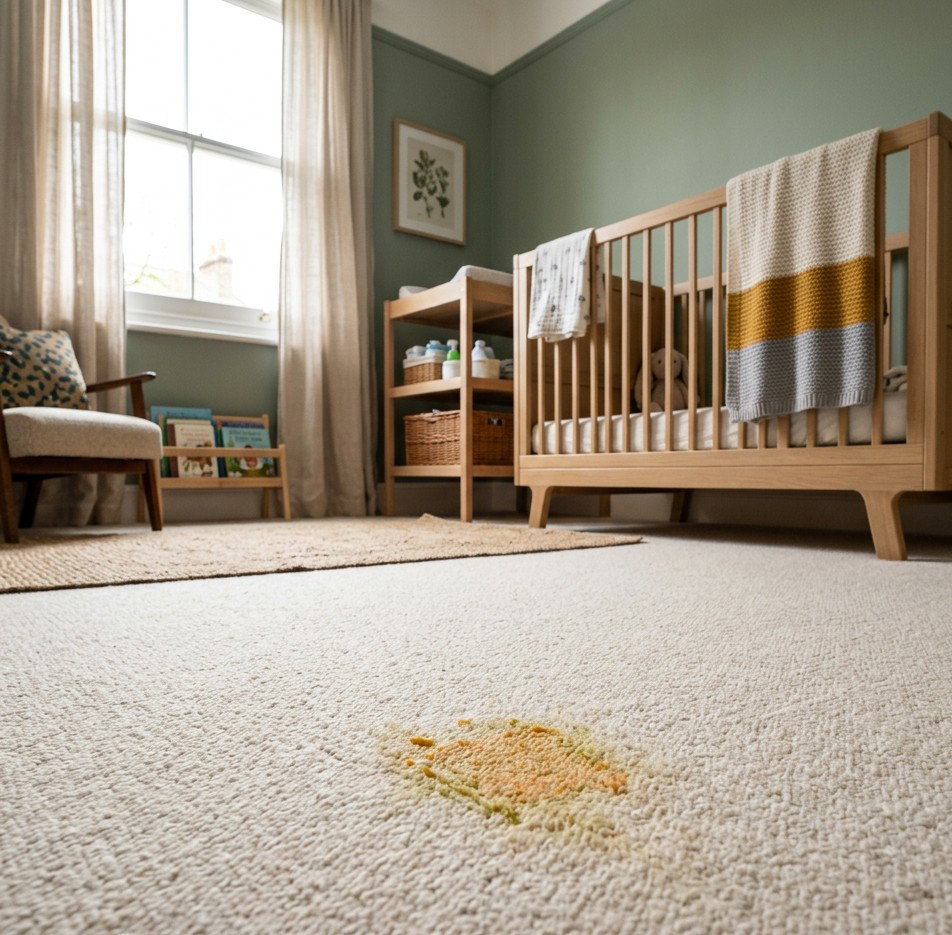
If you have ever surveyed a nursery carpet at the end of a weaning week, you will know that the words “cleaning challenge” do not quite cover it. There is the orange arc of pureed carrot that somehow travelled further than physics should allow. There is the milk patch that dried invisibly and revealed itself only by smell, three days later. There is the nappy incident that required the focused attention of two adults and a full roll of kitchen paper. Nursery carpets take more punishment per square metre than almost any other surface in the home – and they require a cleaning approach that is both effective and safe for a small person who spends much of their day with their face very close to the floor.
Why Nursery Carpets Demand a Gentler Approach
Close-Contact Flooring and the Case for Mild Solutions
The single most important thing that distinguishes nursery carpet cleaning from cleaning anywhere else in the home is proximity. Babies and toddlers crawl, roll, sit, and press their faces directly onto the carpet. Whatever remains in the pile after cleaning – residue, fragrance compounds, chemical traces – ends up in contact with their skin, their hands, and inevitably their mouths.
This rules out a significant proportion of the standard carpet cleaning arsenal. Strong detergents, bleach-based products, and heavily fragranced commercial fresheners are all inappropriate in a nursery context. The goal is to clean thoroughly using the mildest effective means available, rinse well, and leave the carpet as chemically neutral as possible. Effectiveness and safety are not in conflict here, but achieving both requires choosing the right product for each stain type rather than reaching for the nearest all-purpose spray.
The Nappy Incident – Dealing with Urine and Faecal Stains
The Most Urgent Clean-Up in the Baby Handbook
Speed matters enormously with biological stains. A fresh nappy leak dealt with immediately is a minor inconvenience. The same leak left for an hour while the afternoon becomes complicated is a significantly harder problem – and one with an odour dimension that lingers long after the visible stain is gone.
For urine, blot up as much liquid as possible immediately using a clean white cloth or generous layers of kitchen paper. Press firmly rather than scrubbing, and work from the outside edge of the wet patch inward. Once the bulk of the moisture is absorbed, apply cold water sparingly to dilute the remaining residue and blot again. Follow with a solution of one part white vinegar to two parts cold water, applied with a clean cloth and blotted dry. Sprinkle bicarbonate of soda over the area once it has dried, leave for several hours, and vacuum thoroughly.
For faecal matter, remove all solid material first using a blunt implement before applying any liquid, then follow the same treatment sequence as for urine. One important rule applies to both: always use cold water, never warm or hot. Heat sets protein-based stains permanently into carpet fibres, turning a treatable incident into a lasting mark.
Enzyme-based cleaners are particularly well suited to biological stains of this kind, breaking down the organic compounds responsible for both stain and odour without the harsh chemicals that make many standard stain removers unsuitable for nursery use. Check that the product is fragrance-free or very lightly scented before applying it in a baby’s room.
Pureed Food Stains – Navigating the Weaning Palette
Carrot, Beetroot, Spinach, and the Art of the Pigment Stain
The weaning stage introduces the nursery carpet to an extraordinary range of highly pigmented, enthusiastically distributed food stains. Each presents its own challenge, and a one-size-fits-all approach will not serve well across the full spectrum of what a seven-month-old is capable of deploying.
Carrot and butternut squash are oil-rich and deeply pigmented. Scrape away any solid residue first, then treat with a small amount of washing-up liquid diluted in cold water – the detergent lifts the oil component while the cold water addresses the pigment. Work from the outside in, blot rather than scrub, and rinse with clean cold water once the stain has lifted to remove all detergent residue.
Beetroot benefits from prompt action above all else – a fresh stain treated immediately with cold water and diluted washing-up liquid will often lift almost completely, while a dried one is a considerably more stubborn proposition. A diluted white vinegar solution applied after the initial treatment can help address any residual pinkish cast.
Spinach, pea puree, and other green foods leave chlorophyll stains that respond well to cold water and mild detergent. Avoid warm water, which can set the green pigment. For any stain with an oily element – avocado, anything made with butter or oil – the detergent step is particularly important, as plain water will not touch the fat component.
Milk and Formula Stains – The Problem That Returns by Smell
Why Dairy-Based Stains Need Complete Treatment, Not Just Surface Cleaning
Breast milk and formula are protein-based, sharing the same critical rule as biological waste: cold water only. Warm water sets the protein into carpet fibres in a way that becomes effectively permanent and, more importantly, seals in the organic material responsible for the sour smell that tends to announce itself several days after the initial incident.
Blot up spilled milk as thoroughly as possible, then treat with cold water and a small amount of mild detergent, working from outside to inside. Rinse well and blot dry. The visible stain from milk is often modest, but the odour risk is considerable in a warm room where organic material breaks down quickly.
For milk stains where the smell has already developed, an enzyme-based cleaner will address the source of the odour rather than simply masking it. Apply according to the product instructions, allow adequate dwell time for the enzymes to work, and rinse thoroughly before the area dries. Bicarbonate of soda applied over the treated, dried area and left overnight before vacuuming provides a useful final deodourising step.
Safe Deodourising in the Nursery
What to Use, What to Avoid, and Why the Distinction Matters
Odour management in a nursery requires particular care. The instinct to reach for a commercial carpet freshener or a strongly scented spray is understandable, but in a room where a small child breathes at floor level, synthetic fragrance compounds are best avoided. Many commercial carpet fresheners also leave a powdery or adhesive residue that is difficult to remove entirely from carpet pile – not ideal on a surface that small hands are in constant contact with.
Bicarbonate of soda is the appropriate choice – fragrance-free, non-toxic, and genuinely effective at neutralising organic odours rather than covering them. Sprinkle it over the area to be treated, work it lightly into the pile with a soft brush, leave for several hours, and vacuum thoroughly. It can be used as a routine deodouriser across the whole nursery carpet, not just on specific stain sites, and is safe to use as often as needed.
White vinegar solution serves as a useful secondary deodouriser for more persistent smells, but ensure the area dries fully before the room is occupied, and ventilate well while it is in use.
Drying Thoroughly – A Step That Cannot Be Rushed
Why a Damp Nursery Carpet Carries Its Own Risks
Thorough drying after any wet treatment is always important, but especially so in a nursery. A carpet that remains damp in a warm, enclosed room will begin developing mould and bacterial growth relatively quickly, creating a secondary hygiene problem in a space specifically designed for a vulnerable occupant.
After any cleaning treatment, blot the area as dry as possible with clean cloths, pressing firmly to draw moisture up from the pile. Open a window to encourage airflow – even briefly in colder months, ventilation accelerates drying considerably. A small fan directed across the treated area helps further. Avoid returning a child to the room until the carpet is fully dry to the touch.
Building a Nursery Carpet Routine
Staying Ahead of the Mess Through the Baby and Toddler Years
The most effective nursery carpet care is preventative and habitual rather than reactive and occasional. Weekly vacuuming keeps loose debris and dried food particles from working deeper into the pile. During the weaning stage, a quick daily inspection of the main play areas and a readiness to treat anything fresh immediately will prevent the accumulation of stains that becomes harder to address with each passing week.
Keeping a small kit to hand in the nursery makes prompt treatment practical – a clean white cloth, a spray bottle of diluted white vinegar solution, a pot of bicarbonate of soda, and a fragrance-free enzyme cleaner cover the great majority of nursery carpet incidents. The difference between treating a pureed carrot stain at the moment it happens and treating it forty-five minutes later, once it has begun to dry, is considerable.
When Home Treatment Is No Longer Enough
Accumulated Staining and the Point of No Return for DIY
Even with consistent care and prompt treatment, nursery carpets accumulate over time. The combination of biological staining, food pigments, milk residue, and the general volume of incidents that the weaning and early toddler years produce means that the carpet in a well-used nursery will gradually build up a layer of embedded soiling that surface treatments cannot reach.
A professional deep clean using hot water extraction removes the embedded organic matter, allergens, and bacteria that a domestic vacuum and spot treatments leave behind – a meaningful benefit in a room used by a young child, rather than a purely cosmetic one. The period after weaning ends, or before a new baby is due, is the natural point at which most families find it worthwhile. In the meantime, prompt treatment, regular vacuuming, and the deodourising routine described above will keep the nursery carpet in the best possible condition through what is, by any measure, its most demanding chapter.